Tai Chi Benefits for Arthritis and Balance: Why I Recommend It to My Patients
I’ll never forget one particular Monday morning years ago — a patient named Jean shuffling into my office, clutching her knee, wincing with every step. She was in her late sixties, but her gait reminded me of my grandfather at 90. "Doc, I just want to get through the grocery store without feeling like I might topple over," she said. "What's something real I can try?"
Here’s the thing: I’ve lost count of how many times patients have asked about non-drug remedies for joint pain and balance. Frankly, most folks have tried the usual suspects—pain gels, heating pads, knee braces. And sure, those have their place (I use them myself when my lower back flares up after a bad golf swing). But when it comes to truly improving long-term mobility, especially for those with arthritis, few tools are as consistently supported by research—or as gentle—as tai chi.
Isn’t Tai Chi Just “Slow Dancing” for Seniors?
If you’re nodding along, you’re not alone. A lot of people dismiss tai chi as “just slow movement,” or some kind of meditative choreography with no muscle behind it. I used to be one of them. But after reviewing clinical data and seeing real results with my own eyes, I’m the first to admit: I was wrong.
The National Institutes of Health highlights tai chi as a remarkably safe way to improve strength, flexibility, balance, and overall well-being — with almost no downside. In 2016, Arthritis & Rheumatology published a randomized trial showing that twice-weekly tai chi practice reduced pain and improved function in knee osteoarthritis patients as effectively as physical therapy. That’s not hype; that’s peer-reviewed evidence.
Living With Arthritis and Balance Issues: The Daily Struggle (And Why It Matters)
If you’ve ever worried about slipping in the shower, feared those last few porch steps, or hesitated to get down on the floor to play with your grandkids — you already know: balance isn’t some abstract concept. It’s the difference between independence and relying on others. It’s quality of life.
Arthritis just layers on even more frustration. Pain nudges us toward the couch, which leads to less movement, which weakens muscles and worsens balance. It’s a vicious cycle I see play out over and over, regardless of whether someone is 45 or 85.
But the real kicker? Most balance problems (and mild-to-moderate arthritis pain) are modifiable. You don’t need to “accept” a slow fade into instability. Tai chi is one of the rare things that truly addresses both issues at once—pain and balance—from the ground up.
What Exactly Is Tai Chi? (And Why Does It Work?)
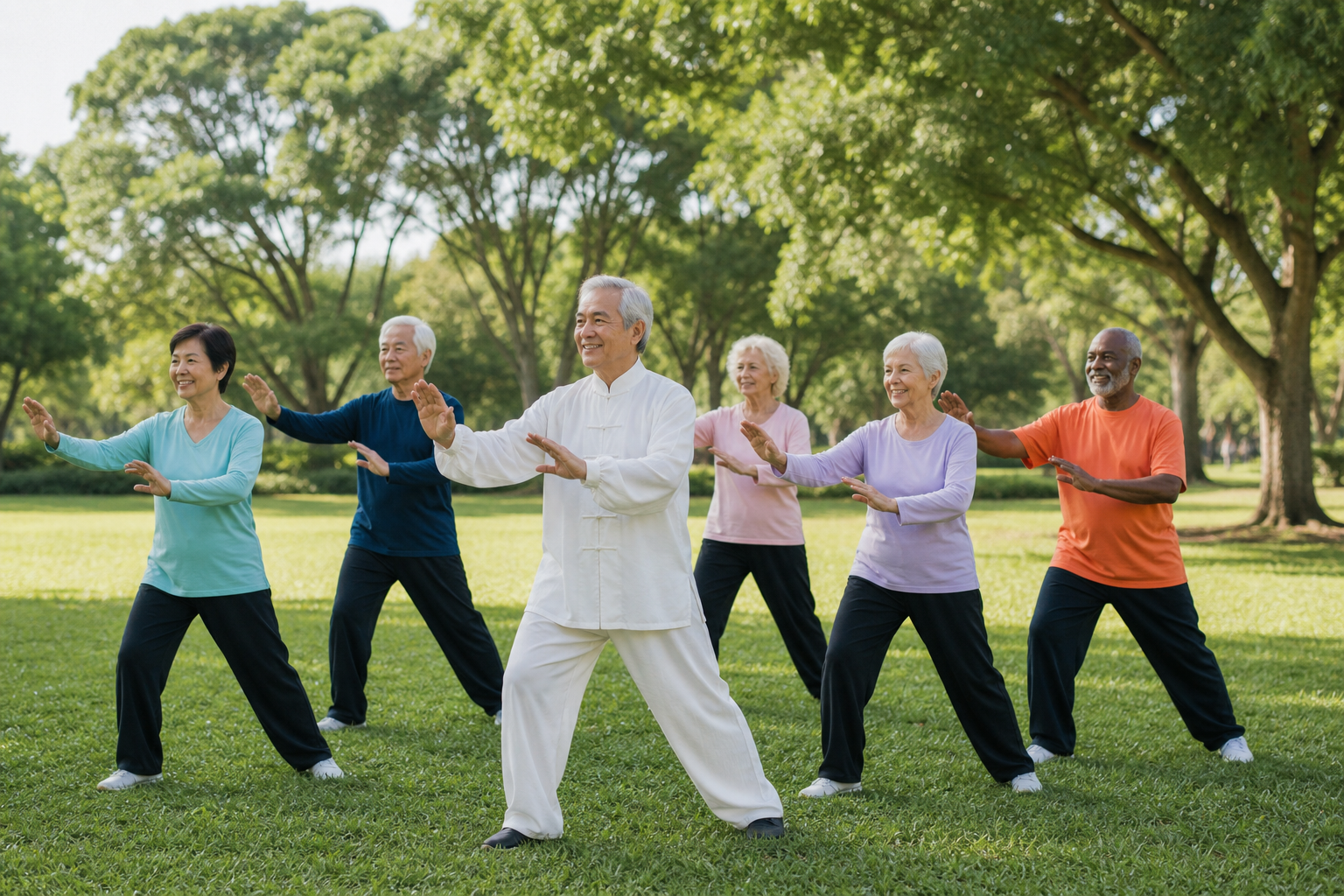
If you’ve never seen tai chi, picture a line of people in a park, moving through a series of slow, controlled steps and arm motions. It’s rooted in ancient Chinese martial arts, but in practice, it’s incredibly approachable. No fancy equipment, no jumping, no dropping to the floor.
So why does such gentle movement pack such a punch for arthritis and balance?
- Mind-Muscle Connection: Tai chi routines emphasize control and body awareness. You’re constantly shifting weight, activating deep stabilizer muscles that typical exercise skips. The Journal of Aging and Physical Activity (2021) found that older adults practicing tai chi improved “proprioception”—that’s your brain’s sense of joint position, which is crucial for preventing falls.
- Low Joint Impact: Movements are fluid and slow. That means less pounding on inflamed knees or hips, reducing flare-ups. A 2013 BMJ review found tai chi safer than many “high-octane” exercise regimens, with lower dropout rates and fewer injuries.
- Anti-Inflammatory Effects: Here’s where it gets interesting. Several studies (including a 2019 Journal of Rheumatology meta-analysis) suggest tai chi may modestly reduce inflammatory markers over time — potentially helping with the root cause of arthritis pain, not just the symptoms.
The Science: Tai Chi for Arthritis and Fall Prevention
I’m not just cherry-picking studies here. We’re talking serious, gold-standard research:
- Arthritis Pain: A 2016 randomized trial in Annals of Internal Medicine found that after 12 weeks, people with knee osteoarthritis practicing tai chi had similar reductions in pain and improvements in walking speed as those undergoing standard physical therapy. That’s huge—especially for those who can’t tolerate (or afford) weekly PT.
- Balance and Falls: The Journal of the American Geriatrics Society reviewed 18 studies in 2017 and concluded tai chi reduces risk of falling by 20-30% among older adults. That’s not just a number. That’s fewer broken hips, ER trips, and phone calls to worried family members.
- Flexibility and Strength: Even as little as 8-12 weeks of tai chi has been shown to boost lower body strength and ankle flexibility—both critical for staying upright on uneven ground.
One of my patients, Joe, who’d had two minor falls in a year (but was stubborn as a mule about “not needing a cane”), told me after a month of tai chi videos, "Doc, I feel steadier. Like, my feet just know where to go again." He’s not alone.
How Tai Chi Eases Arthritis Symptoms (Hint: It’s Not Magic)
Let’s be real: tai chi isn’t a miracle cure. If you have severe joint damage, it won’t regrow cartilage or replace the need for medication. But the cumulative benefits are surprisingly broad:
- Reduced Pain and Stiffness: Gentle motion lubricates joints and encourages synovial fluid flow. Most participants in tai chi studies report mild-to-moderate pain reduction within 4-8 weeks — sometimes faster when combined with topical relief (I’ll mention a favorite below).
- Improved Mood: Chronic discomfort messes with your head. Tai chi’s meditative aspects help ease anxiety and frustration, which actually makes pain easier to tolerate. (The 2018 JAMA Network Open study found lower depression scores in arthritis patients after tai chi practice.)
- Functional Fitness: Climbing stairs, getting out of chairs, and even turning to reach for a mug become easier as core and leg strength improve.
My advice? Don’t expect fireworks on day one. Consistency is everything. Even 10-20 minutes, 2-3 times per week, can start to retrain your balance reflexes. This is a "long game," but the payoff is huge.
Tips to Get Started With Tai Chi (Even If You’re Skeptical or Stiff)
Look, I know some of you are reading this and thinking, "Seems great, but I can barely get off the couch some days." I hear you. Here’s how I coach my own clients to get rolling, even with cranky knees or zero experience:
- Start Small: There’s no need to join a class right away. Even following a five-minute YouTube routine counts. (Search for "tai chi for beginners arthritis"—there are some surprisingly good free videos.)
- Use a Chair If Needed: Many moves can be done seated at first. Don’t worry about memorizing every pose. Just focus on smooth, pain-free movement.
- Support Your Joints: If arthritis is flaring, consider pairing movement with a topical pain gel. I’ve reviewed dozens—Voltaren Arthritis Pain Gel is one of the few with solid evidence (diclofenac sodium, FDA-approved, I use it myself on ‘bad elbow’ days). It won’t fix the root, but it can make getting started less daunting. Always talk to your doctor if you’re taking other NSAIDs or have stomach issues.
- Find Community: Community centers, YMCAs, and local arthritis foundations often offer tai chi classes for all levels. My mother-in-law finally joined one after months of YouTube-ing alone — and swears the social side is half the benefit!
- Track Progress: Notice if you’re standing up with less grunting, or tackling stairs with less hesitation. These little wins add up, even if you’re not doing textbook-perfect poses.
More Than Movement: Addressing Anxiety, Sleep, and Confidence
What surprised me most as a clinician isn’t just the physical payoff. It’s the ripple effect on anxiety and sleep. Patients often report feeling calmer, sleeping better, and even approaching other forms of exercise with more confidence after a few weeks of tai chi.
The meditative focus rewires how your body interprets pain signals. For anyone dealing with the “pain-fear cycle”—that dread of moving because it might hurt—tai chi gently breaks that link. That’s not just my opinion; it’s supported by a 2022 Pain Medicine review, which found reduced "fear avoidance" behaviors in participants after starting tai chi.
What About Other Tools? Combining Tai Chi With Joint-Friendly Support
I’m a firm believer in the "toolbox" approach. Tai chi addresses the "software"—the way your body moves and senses itself—but sometimes, a little "hardware" support doesn’t hurt. Here are a few extras that my patients have genuinely benefited from (and yes, I’ve put them through the wringer myself):
- Stability Braces: If your knees feel wobbly or you have a history of falls, a medical-grade brace can give you the confidence to try new movement. The NEENCA Professional Knee Brace is one I recommend for its side stabilizers and comfy fit. Especially if you’re new to exercise, a little extra support can mean the difference between "I'll try it" and "Nope, too risky." Don’t wear it 24/7—your muscles still need to work!
- Home Exercise Guides: Some folks want more structure. Treat Your Own Knees by Jim Johnson is a plain-English, research-backed book I’ve handed out for years. It’s not just exercises (though they’re good)—it helps you troubleshoot and set realistic goals. Pair it with tai chi, and you’ve got a complete program for mobility.
What Most Articles Won’t Tell You About Tai Chi (And a Few Honest Caveats)
Now, I know there’s a lot of cheerleading for tai chi out there that glosses over the caveats. Here’s my honest take:
- Yes, results take time—don’t toss out your pain gels or braces after one class. Most of the research tracks improvements after 8-12 weeks of regular practice.
- If you have severe balance problems or dizziness, consult your doctor or a physical therapist before starting—sometimes a modified routine, or one-on-one instruction, is safer.
- Some folks with advanced arthritis (bone-on-bone knees, for example) may need additional interventions. Tai chi can help the rest of the body, but don’t expect miracles for severely damaged joints.
- And a heads-up: While tai chi is low-risk, any new exercise can cause some soreness if you go too hard, too fast. Listen to your body and take breaks.
But for most people in the “early-to-moderate” arthritis camp, or those simply wanting to stay steady on their feet as birthdays pile up, I’ve yet to see a more approachable and evidence-backed routine.
The Big Takeaways (And How to Make It Stick)
- Tai chi isn’t flashy, but the research is real: Repeated studies show less pain, better balance, and improved confidence.
- Start slow, support your joints as needed, and track your wins: Progress might be subtle, but it stacks up.
- Consider combining tai chi with other proven supports: Topical gels, stability braces, and home guides can all play a role—don’t be afraid to mix and match.
- Find what works for you: The best routine is the one you’ll actually stick with.
Whatever path you take, I hope you give tai chi a fair shot. If my clinic’s experience is any clue, you might be surprised at what a few slow steps can unlock.
Have questions or want to share your own story? Drop me a line—I really do read every message.
To easier movement, better balance, and fewer ouch moments,
Dr. Michael Torres, DC
Chiropractor, Nutrition Counselor, JointReliefReviews.com Contributor