
Why My Patients Keep Asking About Hyaluronic Acid for Knees
I’ll never forget the look on my neighbor Joan’s face the day she hobbled over, clutching her swollen knee and a bottle of some hyaluronic acid capsules she’d bought online. “Linda, be honest — is this stuff legit, or did I just waste forty bucks?” she begged. She’s not alone. Knee pain is relentless, and we’ll try just about anything for relief. Over the past couple years, I must’ve fielded this question a hundred times, from my mother-in-law to readers in my inbox: do hyaluronic acid supplements for knees actually work?

Why Knee Pain Feels So Personal
If you’re nodding along, you’re not alone. According to the CDC, nearly one in four adults has some form of chronic knee pain. For some, it’s a dull ache that shows up on rainy days or after a long walk. For others, it’s a sharp, grinding pain that makes you dread the stairs. And here’s the thing: joints aren’t like car parts you can just swap out easily. Sure, there’s surgery, but for most of us, we want options that don’t involve scalpels or medical bills that look like phone numbers.
Knee problems don’t just disrupt your weekends — they hijack your sleep, your mood, and even your independence. I’ve seen it firsthand in my twenty years as an orthopedic nurse. People want something they can try today, at home, without scary side effects. That’s where the surge of interest in hyaluronic acid comes from.
What Even Is Hyaluronic Acid? (And Why Is It in Supplements?)
Let’s clear up the basics. Hyaluronic acid (HA) is a substance your body actually makes on its own. Most of it lives in your skin, connective tissues, and — you guessed it — your joints. The main job? Acting as a natural lubricant and shock absorber. In healthy knees, HA helps the joint glide smoothly. But with age or injury, those levels drop, and things get creaky. That’s when cartilage wears thin, bone rubs on bone, and you’re left searching for relief.
HA first made a name for itself with injections (called viscosupplementation). If you’ve ever had a doctor recommend shot after shot in your knee, that’s pure hyaluronic acid being injected right into the joint. (The science there is… complicated. Some people swear by it, others see only modest improvement. The American Academy of Orthopaedic Surgeons is pretty lukewarm.)
But here’s where it gets interesting: supplements. Capsules, powders, gummies — all promising to “restore” joint lubrication from the inside out. It sounds almost too easy, doesn’t it?
The Real Science: Do Hyaluronic Acid Supplements Help Knees?
I’ll be honest — I was skeptical at first. Swallowing a pill and expecting it to reach your knees? But science is always evolving, so I keep an open mind. Let’s walk through what the research actually says.
What Clinical Trials Say
In 2016, a double-blind study published in Clinical Nutrition tracked 60 adults with knee osteoarthritis who took 200mg of oral HA daily for a year. The results? After 12 months, the supplement group experienced modest but significant improvements in knee pain and function compared to placebo. “Modest” is the keyword there — not a miracle, but definitely not a dud.
And there’s more. A 2021 meta-analysis in Arthritis Research & Therapy pooled several high-quality trials and found that oral hyaluronic acid (at doses of 120-240mg daily) provided consistent, albeit moderate, improvement in pain and stiffness scores versus placebo. The benefits seemed to build over 8-12 weeks of use — not overnight relief.
One thing I tell everyone: if you stop after a week, you’re not giving it a fair shot. Most studies show best results after two to three months. That’s true for most joint supplements, honestly.
The Absorption Debate: Can HA Even Reach the Knee?
Here’s the controversy: hyaluronic acid is a big molecule. Old-school thinking argued it just gets broken down in your gut, so oral supplements would be a waste. But more recent research (including a fascinating 2020 paper in Journal of Agricultural and Food Chemistry) suggests that low-molecular-weight HA can be absorbed in the intestines. Once in the bloodstream, animal studies show it DOES reach joint tissues — though how much and how efficiently is still up for debate.
Is it as direct and potent as an injection? Of course not. (I’ve seen some supplement companies claim their pills are “as effective as shots.” That’s marketing, not medicine.) But the bottom line: enough gets through to make a clinical difference for some people, especially those with mild to moderate knee issues.
Who Might Benefit Most?
If you have mild or early-stage knee osteoarthritis, the odds are better. The research is less convincing in advanced disease where there’s bone-on-bone grinding. Healthy adults with occasional knee aches from sports or running? The science isn’t as clear, but some folks notice less post-exercise soreness. I’ve seen patients in their fifties and sixties with “morning stiffness” report the most improvement.
Another reader, Dan, emailed last month. He’s 58, cycles everywhere, and struggled with swelling after long rides. Three months on hyaluronic acid, and he noticed less crunching and quicker recovery. His wife tried it for hip pain — not much luck. Like most supplements, your mileage may vary.
And — quick disclaimer, because I have to say it — if you’re pregnant, breastfeeding, or have complex medical issues, talk to your doctor before adding a new supplement. Especially if you’re already on medications for arthritis or blood thinners.
The Right Dosage: What Actually Works?
Most clinical studies use low-molecular-weight HA at 120–240mg per day. Don’t bother with megadoses — your body can only use so much. Look for brands that specify the molecular weight (lighter is better for absorption) and clearly list their dosage per serving.
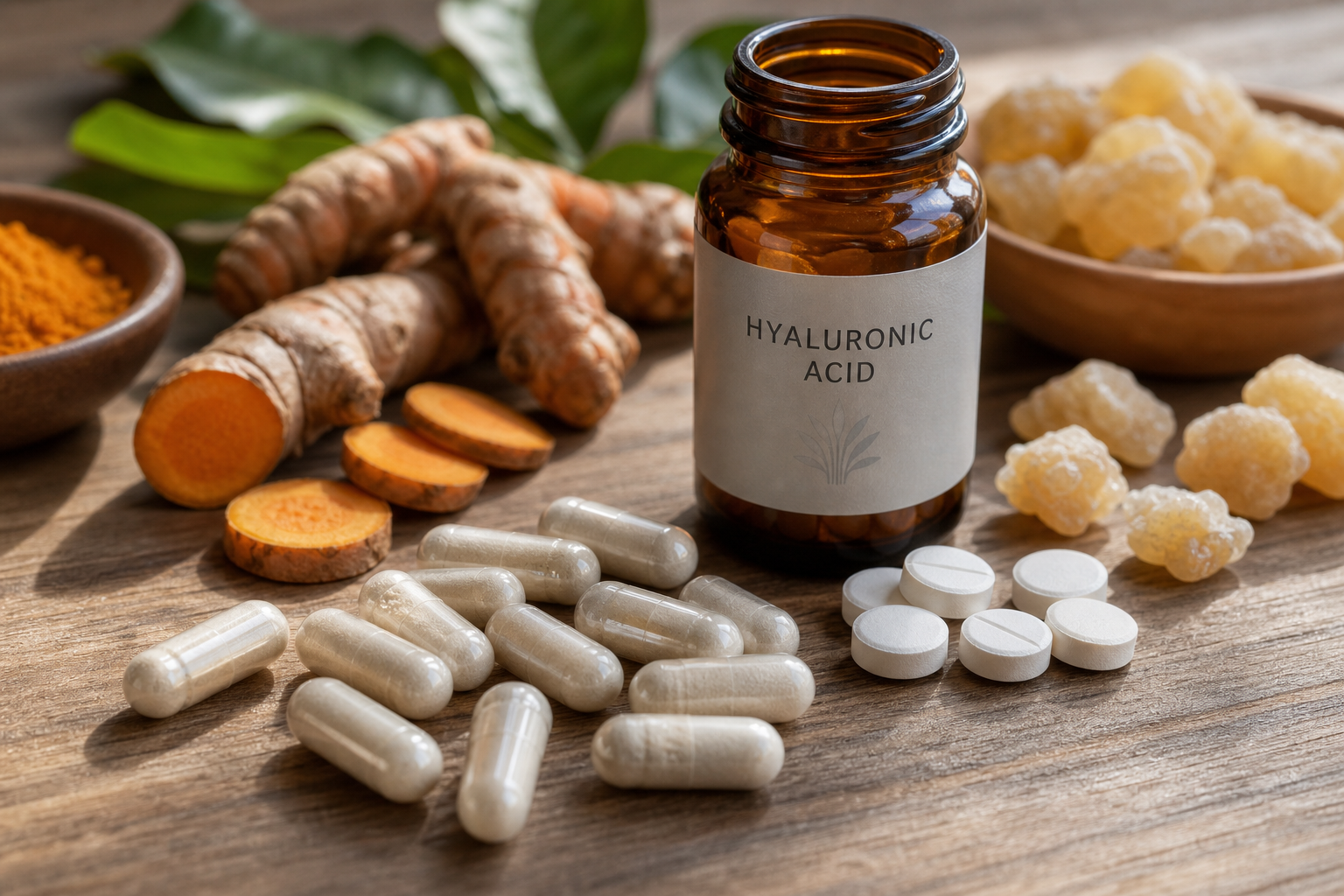
And here’s something most articles won’t tell you: some of the best joint formulas combine hyaluronic acid with other evidence-backed ingredients. Glucosamine, chondroitin, turmeric, MSM, and boswellia show up together for a reason. They hit different pain and inflammation pathways. (It’s the difference between sending in a solo player versus an entire team.) One of the more popular combos I’ve seen is Glucosamine Chondroitin Turmeric MSM & Boswellia. It stacks up well on ingredient quality — and has real hyaluronic acid in the formula too.
HA Supplements vs. Other Knee Pain Relief Options
- Injections: As I mentioned, HA injections are FDA-approved for moderate knee osteoarthritis, but they’re not cheap, and insurance coverage is spotty. Plus, not fun (needles into the joint are nobody’s idea of a good time).
- NSAIDs: Pills like ibuprofen or topical gels (I’m thinking Voltaren Arthritis Pain Gel) work for short-term relief but don’t “fix” the underlying lubrication problem. Long-term, NSAIDs can be hard on your stomach and kidneys, especially over age 60.
- Physical Therapy and Bracing: Still the gold standard in my book. Strengthening the muscles around your knee, keeping your weight healthy, and using supportive gear (like the Modvel Compression Knee Brace) can make a world of difference. Supplements are a bonus, not a substitute for movement.
There’s no magic pill. But combining these strategies — supplements, movement, occasional anti-inflammatories, smart bracing — gives you a real shot at better knees without surgery.
Potential Side Effects and What to Watch For
Thankfully, hyaluronic acid supplements are among the safest in the joint health aisle. The Journal of Rheumatology (2019) reported only mild side effects like bloating or stomach upset, and even those were rare. Allergic reactions are unusual, but possible — especially if you’re sensitive to ingredients derived from eggs or chicken (some HA is sourced from rooster combs — read your labels, folks!). Plant-based or vegan formulas are now pretty easy to find.
And not gonna lie — if you’re on a budget, HA isn’t the cheapest supplement out there. Some formulas are loaded with fillers or under-dosed. Stick with brands that test for purity and list third-party certification, especially if you’re taking it daily for months at a time.
What Actually Improves Knee Health? (My Real-World Advice)
Here’s the real kicker. Supplements — even the best ones — work best as part of a bigger plan:
- Stay active (but gentle): Walking, swimming, and cycling keep the joint lubricated by moving fluid in and out. Too much rest is just as bad as too much pounding.
- Strengthen your leg muscles: The stronger your quads and hamstrings, the less pressure on your knee joint. If physical therapy isn’t an option, look for trusted free routines online.
- Manage your weight: Even dropping 10 pounds can mean 40 pounds less pressure on your knees, step for step. I know, easier said than done — but it matters more than any supplement.
- Support when needed: Compression sleeves, like the Modvel Compression Knee Brace, are a reader favorite for both workouts and sitting at your desk. The right support gives your joint a break while you build strength.
- Smart supplementation: If you want to try HA, give it at least 8-12 weeks before deciding whether it’s helping. Consider a joint formula with multiple ingredients for broader support.
And yes — always let your primary care provider know if you’re adding new supplements, especially if you have medical conditions or take prescription meds.
What I Tell Friends & Family: My Honest Take on HA Supplements
People sometimes expect me to have a black-and-white answer, but knee pain doesn’t work that way. Here’s my honest take, after seeing patients try everything from surgery to snake oil:
- For those with mild to moderate knee pain, especially from early osteoarthritis, hyaluronic acid supplements are worth a shot for a few months. The research isn’t “earth-shattering,” but it’s better than most other trendy supplements I’ve reviewed.
- If you have severe, late-stage bone-on-bone arthritis, don’t expect miracles. But if your main issue is stiffness (not just pain), the lubrication effect can be noticeable for some.
- Combinations seem to work better than HA alone. That’s why I often recommend a formula like Glucosamine Chondroitin Turmeric MSM & Boswellia (it covers your bases for about a dollar a day).
- Don’t skip physical therapy or lose hope if the first supplement doesn’t work. This is a marathon, not a sprint.
I know this is unpopular, but sometimes the best results come from blending a few approaches: movement, support, and smart supplementation — not looking for a single “fix.”

Big Takeaways (and a Bit of Tough Love)
If you skipped to the end, here’s what matters: Hyaluronic acid supplements may help lubrication and pain in knees, especially if your arthritis isn’t too advanced. The effect probably won’t be dramatic — but modest improvements can mean the difference between dreading the stairs and enjoying a walk around the block. Give them 2-3 months before you judge. Combine with movement and support. And be a smart shopper: check reviews, dosages, and sourcing.
Knee pain can feel like it’s running the show, but you’ve got more control than you think. I’ve seen small tweaks add up to big changes — and if hyaluronic acid gives you even a little more cushion, it’s worth exploring.
Wishing you knees that let you chase grandkids, walk the dog, or just get through the grocery store without a wince. And if you try something that works (or flops), drop me a note. I learn just as much from readers as from medical journals.
Linda Hargrove, RN
Orthopedic Nurse & Health Columnist
JointReliefReviews.com